Traditionally, the end of the Camino de Santiago is the city of Santiago de Compostela, located in the region of Galicia in northwestern Spain. The culminating point of the pilgrimage is the Cathedral of Santiago, where the remains of the Apostle St. James are believed to lie.
Upon arriving in Santiago, pilgrims usually make their way to the Plaza del obradoiro, which is located in front of the façade of the cathedral. This square is also a meeting point for those who have traveled different routes, as the Camino encompasses an extensive network of path that coverge here.
To complete the end of the pilgrimage, many pilgrims also go to the Pilgrim’s Office in Santiago, where the Compostela is awarded. It is also common to attend the pilgrim’s service in the cathedral. which is celebrated daily at noon.
Although most people associate the Camino de Santiago with the full pilgrimage to Santiago de Compostela, it is important to note that many pilgrims choose to do the Camino in sections. This allows you to tailor the experience to your needs, time constraints and conditions.
What is the last stage of Camino de Santiago?
You should bear in mind that the Camino de Santiago consists of several routes, known as “caminos” or “vías”, which extend throughout Spain and, in some cases, beyond its borders. Each of these routes has its own final destination, which is usually Santiago de Compostela.
Therefore, the last stage of the Camino de Santiago will depend on the route you choose or, if you do it in sections, the city where you decide to end your pilgrimage. To understand why most routes end in Santiago de Compostela, it is necessary to understand its history.
The Cathedral of Santiago de Compostela, Camino de Santiago final destination
The Cathedral of Santiago, as the end of the Camino de Santiago, stands as an architectural testimony that has evolved over the centuries. Construction of the Cathedral began in the 11th century mainly in the Romanesque style, with features such as sturdy walls and simple geometric forms denoting the architecture of the time. However, as the cathedral witnessed several extensions and renovations over the centuries, elements of additional architectural styles were incorporated.
The Obradoiro façade, added in the 18th century, is an outstanding example of Spanish Baroque. This impressive façade is distinguished by its exhuberant ornamentation, elaborate sculptural details and an imposing staircase leading to the main entrance. This Baroque addition complements and enriches the overall appearance of the cathedral, creating a harmonious synthesis with the original Romanesque architecture.
One of the cathedral’s most precious treasures is the Portico de la Gloria, a Romanesque masterpiece carved by Master Mateo. This sculptural ensemble, located at the main entrance, represents a detailed and expressive display of biblical figures and sacred narratives. Each sculpture contributes to a striking visual experience, capturing the attention and admiration of those who enter the cathedral.
The rich combination of architectural styles not only provides a visual spectacle but also highlights the cathedral’s ability to adapt and transform over time, making it a cultural and historical landmark of great importance.

Subscribe to our newsletter and receive our FREE Practical Guide to the Camino de Santiago. In this guide you will find all the information you need to start planning your Camino.

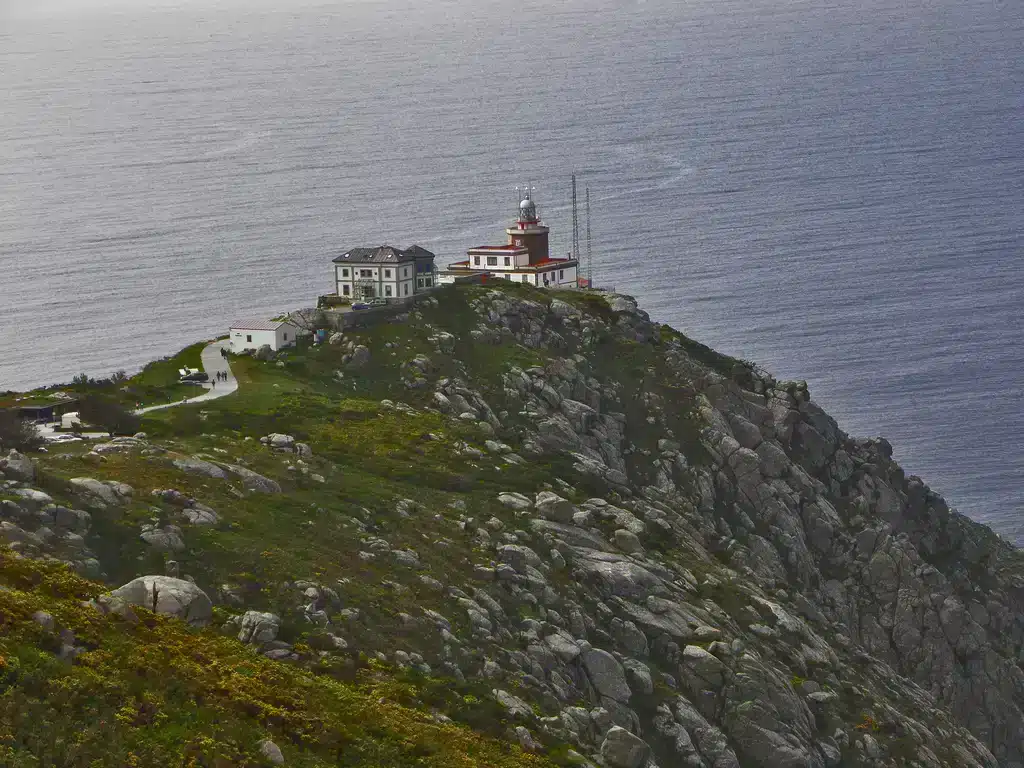
The Finisterre Lighthouse, another end of the Camino de Santiago
The Finisterre Way has its starting point in Santiago de Compostela, unlike the rest of the Camino routes. This route is the extension of the Camino that links Santiago with the amazing Costa da Morte in the northwest Spain.
The Finisterre Lighthouse, located at what was known in Roman times as the “End of the World”, marks the end of the Finisterre Way. The original lighthouse, built in the 19th century, has a sober and functional architecture, typical of the period.
The visual experience of the Finisterre Lighthouse at the end of the Camino is striking, especially at sunset, when the sun dips below the Atlantic horizon. As you approach the Finisterre Lighthouse, the connection to the Atlantic Ocean and the sense of being at the “End of the World” add a spiritual dimension to the experience.
Camino de Santiago planner
Once the route has been chosen, it is essential to draw up a detailed itinerary that includes the daily distances covered, possible rest days and overnight stays. Remember that as a Camino de Santiago Travel Agency we design tailor-made itineraries adapted to your needs, preferences and budget and we book all the services for you.