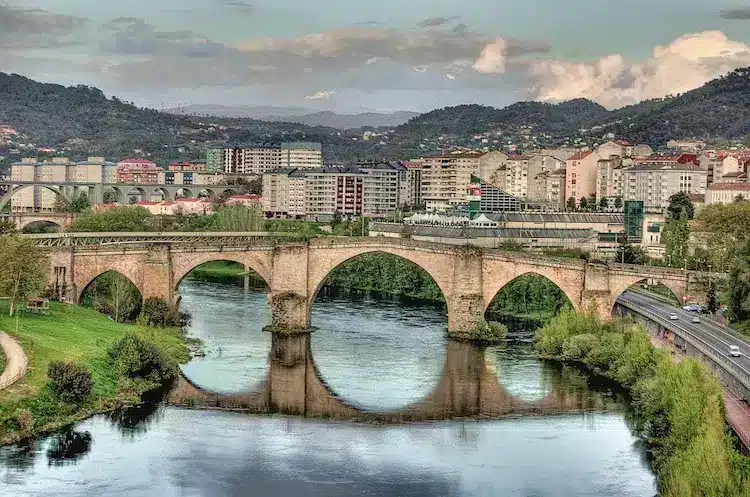
A journey that will lead you to discover the thermal lands of southern Galicia and the true spirit of the Camino along the Via de la Plata.
We design your Camino de Santiago to measure, adapting stages, accommodation and services to your pace, preferences and budget.
Accommodation in private rooms with en-suite bathroom, so you can rest comfortably at every stage.
We include the pilgrim credential so you can stamp your Camino and obtain the Compostela when you arrive in Santiago.
We transfer your luggage from one accommodation to the next at every stage, so you can walk light and worry-free.
Breakfast and half-board options so you can enjoy the local cuisine throughout the Camino.
We offer private transfers to reach the start of the Camino, or any point of the route you need, comfortably.
We send you a travel kit with maps, route notes and practical information, so you have everything you need before you start.
We support you with 24-hour assistance before, during and after the Camino to help with any need or incident.
Would you like to adapt one of these trips?
Tell us your dates and preferences and we will prepare a personalised proposal for your Camino.
Read the opinions of pilgrims who have already traveled with us.


| DISTANCIA: | ETAPAS: | DURACIÓN: | DIFICULTAD: | INICIO: |
|---|---|---|---|---|
| 115 Km | 6 Etapas | 7 Noches | 3/5 | Ourense |

The city of Ourense located in the province of the same name, in the region of Galicia, has a rich history that dates back to the Roman era. Currently, this municipality, known for its hot springs, is presented as a modern city that preserves its architectural heritage, with charming cobblestone streets.
Its connection with the Vía de la Plata It is an essential part of its history, being a crucial point on your route to reach Santiago de Compostela.
The Vía de la Plata is an itinerary of medium difficulty. You must keep in mind that the level of difficulty of this path may vary depending on the starting point, how you decide to divide the stages, your physical condition and the weather conditions at the time of the trip.
The Vía de la Plata has an approximate length of 107 kilometers. This section is considered short compared to some other routes of the Camino de Santiago, but even so, it can take several days of walking. The stages have an average of 20 kilometers, so you will walk an average of between 4 and 6 hours a day. Keep in mind that the distance covered each day can affect the feeling of difficulty, so it is important to plan stages appropriate to your fitness level.
Terrain varies along the Vía de la Plata, from rural roads and forest tracks to urban sections. In general, the route is characterized by mixed terrain, some of which can be uneven or steep and also full of stones. You will be able to find dirt roads, paved roads and trails along your route.
The Vía de la Plata does not have as pronounced slopes as some routes on the Camino, but < strong>presents certain elevations along the route, such as the climb from Ourense to Dozón, in which the terrain rises from 100 meters in altitude to 700. It is recommended that you be prepared to >moderate ascents and descents in some sections.
The route of the Vía de la Plata is well signposted< /strong> and can be done following the signs that indicate the route of the Camino: stone markers, the tile of the iconic scallop shell on the facades of buildings or urban constructions, yellow arrows, bronze scallops embedded in the floors of the streets , etc.
We recommend that you look for these signs in the urban or rural geography to be able to follow the Camino to Santiago, since sometimes they may be hidden or covered by some element such as cars or people, causing you to follow the wrong path. If you arrive at an intersection without any indication and you don’t know how to proceed, we recommend that you go back to the last sign you saw to try to reorient yourself.
Important note :
You may come across signage shaped like the iconic scallop shell. If it is not accompanied by a yellow arrow, you must follow the shell through its open part, that is, the semicircular part with the largest diameter, as if it were an imaginary arrow.
This itinerary, also known as the Mozarabic Way to Santiago, is distinguished by its unique character, crossing ancient Roman roads and changing landscapes, taking you through lush forests and picturesque villages. This route will allow you to discover monasteries and leafy valleys, such as the Ulla River.
The route crosses dirt roads, forest tracks and rural sections, where you can discover the beauty of the Galician rural landscape. In addition, gastronomy plays a fundamental role in this Camino with well-known dishes such as Lalín stew or Cea bread.
The Vía de la Plata will take you through a unique experience. This path, forgotten for a long time and nowadays little traveled, will become an opportunity to connect with yourself and with nature.
The Vía de la Plata route consists of approximately 107 kilometers. The Camino begins right in the city of Ourense and runs through the provinces of Ourense, Pontevedra and A Coruña until reaching the city of Santiago de Compostela.
Some of the towns along the along the Vía de la Plata are:
This municipality, also located in the province of Ourense, is known as the town of good bread, since it has with a centuries-old baking tradition. Cea Bread is a product traditionally made following the ancestral techniques of the area itself and also has the Protected Geographical Indication, one of the European quality regimes.
Today, Cea < strong>combines its historical heritage with a welcoming and modern atmosphere, where its artisan bakeries are a living testimony of the local dedication to baking excellence. In this town, you will be able to discover not only the beauty of its landscapes and the quality of its bread, but also the richness of its history and the warm welcome of its inhabitants, making Cea an unforgettable stop.
This charming town located in the province of Pontevedra fuses its cultural heritage with the characteristic hospitality of the region. The town is known for its deep-rooted gastronomic tradition, especially for its stew festival, which has been celebrated since 1969 and is one of the most important gastronomic festivals in Galicia.
Today Today Lalín is presented as a place where tradition and innovation coexist harmoniously. Its celebrations, such as the renowned Entroidoor Carnival, are vibrant expressions of local cultural identity and attract visitors from all over the world.
This A town in the province of Pontevedra stands out for its serenity and rural beauty. Today, Silleda maintains its original charm while embracing modernity. Its Livestock Fair is one of the most important celebrations in Galicia.
With its bucolic landscapes and quiet atmosphere, this town becomes a haven of bread for those looking for a break on their pilgrimage.
This small municipality, located in the province of Pontevedra, is a hidden treasure for pilgrims who travel the Vía de la Plata. Puente Ulla stands as a silent witness to the rich history and culture of the region.
With its picturesque landscape, crossed by the Ulla River, Puente Ulla creates a serene environment that invites reflection and restduring the journey of the Camino de Santiago.
Other important towns on the Vía de la Plata from Ourense are: Dozón (O Castro) and Outeiro.

The Cathedral of San Martiño is an architectural jewel located in the city of Ourense. Its history dates back to Roman times, when a Christian basilica was built in the 6th century on the same site as the current cathedral.
The construction of the cathedral that we admire today began in the 16th century. XII in Romanesque style, but over the centuries it has undergone several remodeling and extensions that incorporated Gothic, Renaissance and Baroque elements. This process of architectural evolution has left the cathedral with a unique fusion
Although its name seems to indicate it, the Vía de la Plata has nothing to do with mines, metals or silver trade, but with the cobblestone they used to make this road, a large slab that In late Latin it was called delapidata, the Arabs became bal’atta and the Christians became de la Plata.
This route originates from the Roman road that crossed ancient Hispania from south to north, linking Mérida with Astorga. Its construction began in the 2nd century BC, and was later expanded by emperors such as Tiberius, Trajan and Hadrian, who extended it to Santiponce (Italica), Seville (Hispalis) and Cádiz (Gades). This route constitutes a two-thousand-year-old extension with a high heritage, cultural and natural value.
Later, this road was used as a strategic route during the invasions that were unleashed on the Peninsula starting in the year 711, also serving as way for the reconquest and repopulation of Christian territory. Over time, it became the main access route for pilgrims heading to Santiago de Compostela from the south.
We recommenddoing the Vía de la Plata in spring and autumn, since that is when the most favorable meteorological conditions to do this Jacobean route.
The autonomous community of Galicia has an oceanic climate that is characterized by mild, rainy summers and cold, rainy winters. Precipitation is abundant throughout the year and the air temperature is usually moderate, with an average annual temperature that ranges between 10 and 15 degrees Celsius.
We do not recommend doing this Camino in winter as the temperatures can go down to 0ºC. Furthermore, since it is the low season, the availability of tourist services decreases unlike other routes, such as the French Way, and some do not open during the winter months.
Doing this route is an acceptable experience for everyone if it is planned appropriately. Even so, you should keep several things in mind before embarking on this adventure:
If you need more detailed information, you can access it here. Remember that each pilgrimage is unique and personal, take your time to enjoy this experience.
Write your own story on the Camino
We help you plan a tailor-made Camino: stages, accommodation and services adapted to you.
Most of our Camino de Santiago tours are self-guided, so dates are flexible. Tell us your dates, route and preferences and we will design a tailor-made itinerary: you can split stages, add extra nights and include or exclude services to adapt the trip to your needs, preferences and budget.
Your personalised proposal will always list the services included. Our trips include private accommodation with an en-suite bathroom, the pilgrim credential, route information and assistance during the Camino. You can also add other services, such as half board, private transfers or extra nights.
We recommend booking as early as possible, particularly if you plan to walk between May and September or during periods of high demand. Booking early generally provides more accommodation options and greater flexibility when designing your stages.
You can request changes after confirming your booking, although availability, timing and the conditions applying to the services already booked will determine whether those changes are possible.
Luggage transfer between stages can be included in our Camino travel packages, but it is not offered as a stand-alone service. All packages must include accommodation.
We design an itinerary tailored to your needs, preferences and budget and book all services for you.
Galicia is our home. We have travelled all the routes of the Camino and have direct contact with the Camino service providers.
We speak several languages, have lived abroad and have been organising trips for people from all over the world for many years.
Hundreds of pilgrims repeat year after year with us. We will strive to make your trip unique, so you will want to repeat the experience too.
We are a team based in Galicia. We know the Camino routes, accommodation and suppliers firsthand, and we support you before and during your trip.
[PENDING VALIDATION: current Travelife designation]
GET 10% OFF
Confirm your reservation between 21/11 and 02/12.