
Roncesvalles is a small village located in northern Spain. Over the centuries, this small village in the Pyrenees has been a place of many multicultural and religious encounters. Also, It has been the site of some relevant historical events.
The relationship of Roncesvalles with the Camino de Santiago dates back to the Middle Ages. At that time it became an important center of pilgrimage and rest for pilgrims traveling from France and other European countries. Through this small mountain village ran the Roman road connecting Bordeaux-Astorga, followed by pilgrims coming to Galicia to visit the remains of St. James the Apostle.
A part of this way belongs to what we know today as the route of the French Way. The Jacobean route with the longest Jacobean tradition and one of the most popular internationally.
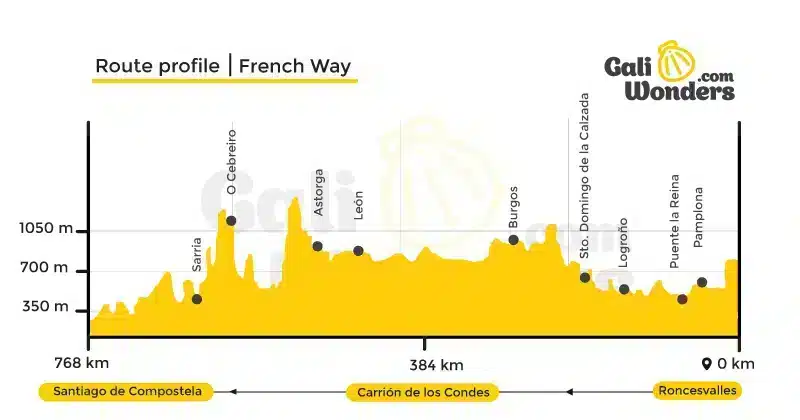
One of the greatest attractions of this Camino is its natural beauty. The Camino from Roncesvalles crosses the impressive mountains of the Pyrenees and passes through all of northern Spain and the variety of its landscapes. The dreamy forests of Navarra, the vineyards and moors of La Rioja, the Castilian-Leonese plateau, the Mountains of León and the Galaico Massif, already in Galicia.
Doing the French Way from Roncesvalles will take you to discover some of the historic towns and villages of northern Spain. You will enjoy its cultural, artistic and architectural richness. And of course, enjoy the gastronomy and wine tourism of northern Spain.


Arrival in Roncesvalles. Although the full French Way starts in St-Jean-Pied-de-Port, the first section is not great for cyclers. That is why the cycling itinerary starts in Roncesvalles.
Pamplona is famous for its San Fermin festival, declared of International Tourist Interest. This city offers an interesting mix of history and modernity. We recommend you to visit the Cathedral of Santa María la Real and the Museum of Navarra, the Royal Palace or the Citadel and its walls.
According to legend, a Navarrese queen ordered the construction of the emblematic Romanesque bridge at the gates of the town, to facilitate the passage of pilgrims over the Arga River.
Leaving Estella behind you will find the Irache fountain, a fountain that provides free wine to pilgrims. It tries to recall the tradition of the monks who gave a glass of wine to the pilgrims who came to the hospital. Many arrived very sick and the wine was used as a restorative. Logroño is the capital of La Rioja region, known for its Denomination of Origin wine “La Rioja” and its delicious gastronomy. You can visit religious buildings, such as the Co-cathedral of Santa María de la Redonda or the Church of San Bartolomé; the House of Science, the Museum of La Rioja. And of course, you can not miss La Calle Laurel. The liveliest street in the city where locals and tourists from all over the world gather for tapas and socializing.
This town became the most important stop on the Jacobean route between Puente de La Reina and León. It owes its name to its founder, Domingo. A hermit who dedicated all his efforts to facilitate the transit through these difficult lands to pilgrims on their way to Compostela. He built a bridge over the waters of the Oja River. He opened a path in the forest to create a safe road. He built a hospital and a temple for the material and spiritual relief of the pilgrims.
Burgos is a city full of history and culture where you can visit many religious buildings. Its Gothic Cathedral, declared a World Heritage Site by UNESCO, the Monastery of Santa María la Real de las Huelgas, the Cartuja de Miraflores, the Castle of Burgo, the Church of San Nicolás de Bari, the Arch of Santa María or the Church of San Gil Abad, are some of the most important monuments.
This is a lighter cycling day, compared to the previous day. We recommend you to stop and visit the remains of the Convent of San Antón.
Today you will cycle through the Meseta of Castilla region. There are many walkers who choose to cycle this part of the Camino de Santiago (and walk the other stretches), because the terrain is great for pedaling.
Today your route runs through the Castilian plateau offering views of farmland. The highlight is in León, capital of the kingdom during the Middle Ages, it has traditionally been a historic enclave on the pilgrims’ way to Santiago de Compostela. It has a Gothic Cathedral and numerous Roman monuments. You can also visit the Convent of San Marcos and the Casa Botines, by the prestigious architect Gaudí.
Before reaching Astorga, the Cross of Santo Toribio will be waiting for you. All pilgrims take a picture with this monument. Once in Astorga, you should visit the Cathedral and the Palacio Gaudí. That is why this stop is so popular among pilgrims!
On this cycling day you will have to face the big ascent towards Cruz do Ferro. Once there, the tradition is taking one stone and throwing it to the cross and make a wish. After this big ascent, there a pleasant descent. One of the highlights of the day: Molinaseca.
You leave Ponferrada towards Galician territory until you reach one of the favorite spots for pilgrims on the French Way. Pedrafita do Cebreiro. A small village located in the Ancares mountain range, in Lugo. Known for its Romanesque church and its “pallozas”, typical traditional constructions of the area.
You will arrive in Sarria, one of the most popular starting points for pilgrims who decide to walk the last 100km of the Camino de Santiago. Among its places of interest are the Tower of Homage and Monastery of the Magdalena.
This is a shorter cycling day, and you will share the path with walking pilgrims. You will cycle along small woods, hamlets, and the rural side of Galicia region. Finally you will arrive in Portomarin, one of the most popular spots of the French Way. Once in Melide, we strongly recommend you to try the traditional dish: pulpo a feira (octopus).
Most of the walking pilgrims will complete the section from Portomarín to Palas de Rei. But if you are cycling, you will continue to Melide. The path will take you to the Sierra de Ligonde, where you will have to face a couple of ups and downs. Once in Melide, we strongly recommend you to try the traditional dish: pulpo a feira (octopus).
As we leave Melide behind, we will start cycling along small woods and rural areas. Arzúa is the next big stop, and where most of the walking pilgrims will stay overnight. If you have time before heading off to Santiago de Compostela, we recommend you to try the local cheese. Some of the highlights of the day: the Chapel of Santa Irena, the hamlet of A Rua or Amenal. Once in Santiago the Compostela, you can deliver the bike in our facilities before checking in.
Check out Santiago.
These hotels offer private rooms with private bathrooms as well as other additional services that may vary depending on the type of category: restaurant service, television, room service, dry cleaning, ironing service, etc. It is common to stay in this type of hotels in the cities along the Camino.
These accommodations have the necessary services to cover the basic needs of cleanliness and rest at a more moderate price than the hotels . Officially, hostels and guesthouses are 1-star accommodations. However, this rating should not be taken into account when evaluating the level of comfort and quality of their services.


To obtain the Compostela you only need to walk the last 100 kilometers of any official route. In the case of the French Way, this requirement is fulfilled starting from Sarria. If you decide to do it by bicycle, you will need to pedal for 200 kilometers, that is, from Ponferrada.
With our bike rental service you can choose between different types of bikes, according to your preferences: mountain bike, gravel bike, road bike, touring bike. And even electric bikes.
A flat tire won’t stop you from getting to Santiago de Compostela! The bike rental service also includes a bike repair kit, so you can patch the bike with your own hands. It is recommended to have some knowledge of bicycle mechanics. Although it is not essential. On the Camino you will always find someone willing to give you a hand!
Yes, you can do the Camino de Santiago with your own bicycle. If you need a bike transport service to get to the starting point of the Camino, we can help you!
Yes, you will be able to store your bike in a safe place in all accommodations. The reception staff will provide you with all the information you need.

| DISTANCE: | 700 Km |
|---|---|
| STAGES: | 15 Stages |
| LENGTH: | 16 Nights |
| DIFFICULTY: | 5/5 |
| STARTING IN: | Roncesvalles |
| PRICE: | from 2352€ |
We will design an itinerary tailored to your needs, preferences and budget and book all services for you. You enjoy the road.
Galicia is our home. We have traveled all the routes of the Camino and we have direct contact with the service providers on the Camino.
We speak several languages, have lived abroad and have years of experience organizing trips for people from all over the world.
Hundreds of pilgrims repeat year after year the experience of traveling with us. We want you to be one of them. And that is why we will strive to make your trip unique and unforgettable.
GET 10% OFF
Confirm your reservation between 21/11 and 02/12.


