Walk the most popular route of the Camino de Santiago from its very beginning, the French village of Saint-Jean-Pied-de-Port. On the full French Way (or Camino Francés) you will be able to discover the most genuine and rural side of Spain, contemplate its diverse landscapes and some of the main cities such as Pamplona, Logroño, Burgos, León, Ponferrada… and finally Santiago de Compostela!
This trip, created by locals, will allow you to meet many fellow Pilgrims from all over the world, taste our delicious gastronomy, and discover both the main cities and the countryside. Forget about your luggage and all the logistics, we will take care of all these details, so you can enjoy the Camino Francés!


Arrival to Saint-Jean-Pied-de-Port.
The lovely village of Saint-Jean-Pied-de-Port has a medieval atmosphere, and a strong presence of the Basque culture. It marks the beginning of the French Way. We strongly recommend to wander around its small streets, to get ready for the Camino.
The first walking day is one of the most challenging of the Camino Francés, but at the same time the views are stunning, from the Pyrenees Mountains. For those who want to avoid long slopes, it is possible to take the route to Valcarlos, through the valley.
We leave France behind, and once in Spain the walk will become a bit lighter than the previous day. Even if the route is called “French Way”, only the first walking day is in France (all the rest is in Spain). The panoramic view of the Pyrenees Mountains will be on your back. You will walk through crop fields, in parallel to the Erro River.
The day will start through a quiet area, in parallel to the Arga River, with many trees and shadows. The last part will became busier, as we approach Pamplona, a great city. There is a lot to do there, for those thinking about adding an extra night, Pamplona is definitely a good choice. One of the best things of the French Way, is that we can visit some of the major cities of Northern Spain.
The first part of the day will be through paved roads, as we leave Pamplona behind. Today you will be able to contemplate the Pilgrim Statue in the Alto del Perdón.
The walk from Puente de la Reina to Estella is quite relaxing, through farms and vineyards. You will walk through the ruins of the Monasterio de la Bogota, wineries, and old Roman bridges, until you arrive in Estella.
Most of the walk passes through small rural areas, surrounded by natural landscapes and vineyards.
This is a lovely stretch, because of the natural areas, until we reach the outskirts of Logroño, the capital city of La Rioja Region. It is a great place to add an extra night. Logroño is also one of the most iconic towns of the Camino Francés.
You will walk through paved roads until you finally leave Logroño; just after, the landscape will become more rural. If this walking day seems to be too long, you can add an extra night in Navarrete, which is in between.
Today the walk will take you through some of the most rural areas of Spain, farms and countryside, away from the main road.
On the way to Belorado, we will walk through small wooden areas and crop lands. We will see the mountains on the horizon, the last ones just before arriving to the “Meseta”. La Meseta: this part is avoided by some pilgrims walking the French Way (it is considered to be the “psychological” stretch of the Camino de Santiago).
You will enjoy a relaxing day, through rural areas, and cross the Oca Mountains.
As we get closer to Burgos, one of the main stops on the Camino de Santiago, the landscape will become more urban.
Once we leave Burgos behind, the walk to Hornillos del Camino will take us through rural areas, and the typical crop lands of this region.
This lovely landscape is very similar to the one seen on the previous day. It is a nice walk through the “Meseta”.
Today we leave behind the Province of Burgos, and arrive into the Province of Palencia. We will arrive into the highest point of the “Meseta”, and see the Pisuerga River (a tributary of the Duero, one of the main rivers in Spain).
The walk to Carrión de los Condes goes in parallel to the Uciesa River, and also to the main road in some stretches.
This walking day is a bit shorter, through rural areas. That’s why we recommend to stop and visit the Monasterio de San Zoilo.
We will find many ups and downs on the way to Sahagún, as we will walk through small valleys. Be ready, as it can be a bit more challenging.
The terrain from Sahagún to El Burgo Ranero is quite flat. It is a quiet walk through farmlands.
This stretch, quite similar to the previous one, has a light descent as we approach León city centre.
The landscape will start to get more urban as we approach the city of León, one of the main stops of the Camino de Santiago. León has a really nice historical quarter, and many buildings that are worth a visit, such as the Cathedral. We recommend to add an extra night here, specially to those who want to discover it in depth.
This walking day is quite flat and quiet. Once we leave behind the suburbs of León, we will find again rural and crop areas.
As we get closer to the Mountains of León, the terrain will become more irregular, with ups and downs. Astorga is a stop with many interesting spots, this town is linked to Gaudí, the architect.
Today we will get into the Mountains of León, surrounded by trees and plantations. The landscape of the “Meseta” is finally over.
On the way to Ponferrada, we will see the Iron Cross (Cruz de Hierro in Spanish, and Cruz de Ferro in Galician), on of the most emblematic symbols of the French Way. It is quite a long route, but really rewarding.
Ponferrada is the starting point for many pilgrims that want to complete the last 200 km of the French Way. The walk, through the Bierzo Region, has a lovely landscape.
The walk to O Cebreiro, is one of the most challenging ones of the whole Camino de Santiago, has the final kilometres go through a long slope.
The walk from O Cebreiro to Triacastela is not as demanding as the previous one. We will see the Pilgrim Monument in the Alto Poio, and finally a nice descent towards Triacastela.
From Triacastela to Sarria, we will enjoy a nice walk through some of the most rural areas of Galicia, we will see small woods, streams and valleys. Sarria is the starting point of most of the Pilgrims walking the French Way, as 100 km is the minimum required to get the Certificate.
A lot of pilgrims start their walk in Sarria, since this town marks the beginning of the last 100 km of the French Way. You will see that the number of pilgrims will radically increase from this point. The walk will take you to some of the most iconic spots of the French Way, such as Morgade, or Portomarín. This medieval town is considered by many visitors, as one of the most beautiful places of the Camino Francés.
The walk will take all pilgrims through rural areas, pine forests, and woods. There will also be time to visit really nice hamlets, with religious constructions, such as Santa María de Castromayor (after leaving behind Portomarín). This stretch finishes in Palas de Rei. There are many restaurants and hotels in Palas de Rei, a town where everything seems to be related to the Camino de Santiago.
The walk from Palas de Rei to Arzúa is the longest of the last 100 km of the Camino Francés. That is why a lot of pilgrims split in two, and stay in Melide. Melide is very popular because of the octopus, we strongly recommend you to taste it if you are around! Just before arriving in Arzúa, you will walk through Ribadiso: the river, the trees, the traditional houses… everything looks like a perfect postcard image.
We strongly recommend you to taste the delicious traditional cheese before you leave Arzúa. This stretch of the French Way continues through small hamlets, eucalyptus forests… One of the highlights of the day: the Chapel of Santa Irene. The final stop of the day is O Pedrouzo. This village is quite small, and limited in terms of accommodation. There are other hamlets around (also on the Camino de Santiago) like Rúa, O Pino, or Amenal. These are also popular spots to stay overnight.
Last walking day of the French Way, that will finally take us to Santiago de Compostela. If you feel it is very long, and you prefer to arrive in Santiago on time for the Pilgrim Mass, you can stay overnight in Lavacolla (just 10 km far from Santiago de Compostela). One of the most emotional moments of the French Way, will be the ascent to “Monte do Gozo”. This is considered to be a moment for self-awareness and reflection. To think about all the magical moments of an adventure that is about to end. Some of the things we recommend you to do once in Santiago de Compostela: -Go to the Pilgrims’ Office to get your “Compostela (Pilgrim Certificate) -Go to the Pilgrim Mass at the Cathedral -Visit the most popular spots of the city: Plaza del Obradoiro, Plaza de la Quintana, the Cathedral…
Last day of the adventure. It is possible to add some extra nights in Santiago de Compostela so you can explore de city. We strongly recommend you to visit Finisterre or the Rias Baixas before leaving Galicia region.

These hotels offer private rooms with private bathrooms as well as other additional services that may vary depending on the type of category: restaurant service, television, room service, dry cleaning, ironing service, etc. It is common to stay in this type of hotels in the cities along the Camino.
These accommodations have the necessary services to cover the basic needs of cleanliness and rest at a more moderate price than the hotels . Officially, hostels and guesthouses are 1-star accommodations. However, this rating should not be taken into account when evaluating the level of comfort and quality of their services.


This small fortified medieval village is one of the most popular starting points on the French Way. It is located in the south of France, close to the Pyrenean border with Navarre. Its narrow, cobbled streets and emblematic architecture led to this citadel being declared a UNESCO World Heritage Site.
For centuries, many pilgrims have chosen to begin their pilgrimage here, adding a sense of historical continuity and tradition to this place. In addition to its Jacobean importance, a few kilometres away is Ostabat, the point where three of the main routes through French territory converge, those from Le Puy, Limoges and Tours.
Roncesvalles is a town in the north of Spain, in the Navarrese Pyrenees, near the border with France. The scene of epic battles and a prime example of French Gothic architecture, it has now established itself as one of the main departure points for pilgrims.
During the Middle Ages, Roncesvalles became an important enclave on the French Way. A hospital was established to provide assistance and accommodation for walkers along the Way; and the church of Santiago, also known as the ‘Church of the Pilgrims’, which houses a sculpture of the apostle St. James inside.
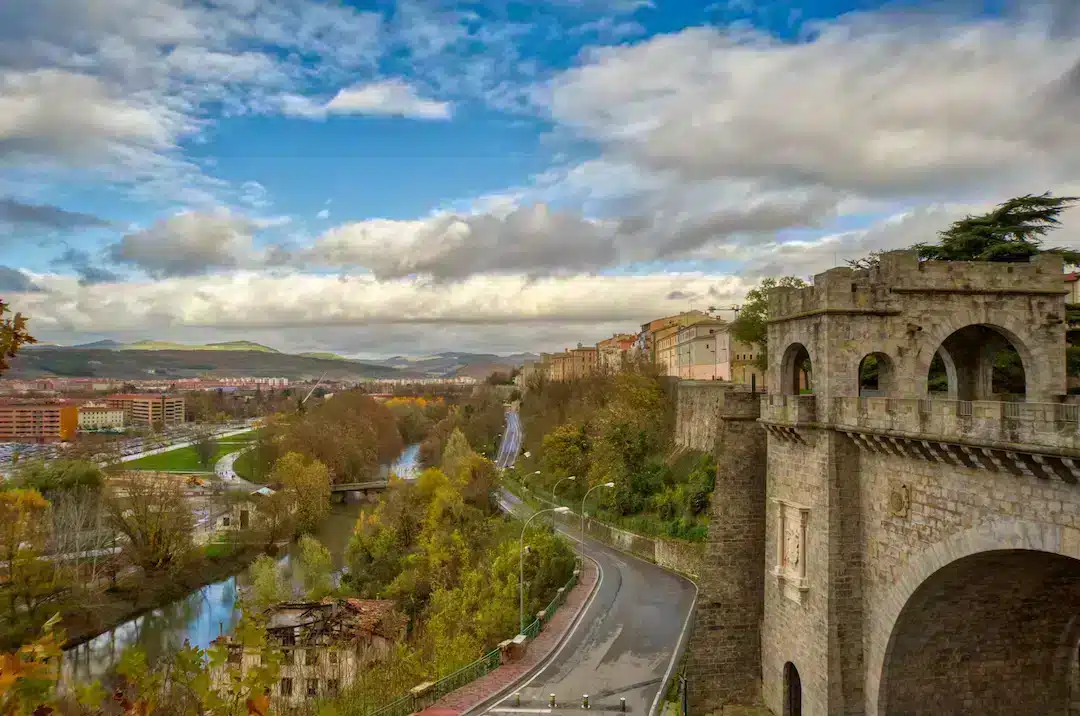
Located in the heart of the Pilgrim’s Way to Compostela, Pamplona is the first city since Roncesvalles. In this city you can visit Ultreia, a Pilgrim Reception and Interpretation Centre on the Camino de Santiago, which presents the history of the city and its relationship with the Saint James Way through interactive and audiovisual resources.
In addition, as a curiosity, Pamplona was chosen by the writer Ernest Hemingway as a place of residence during the Spanish Civil War in search of inspiration for several of his reports and novels, in which he wrote about its San Fermín fiestas.
It is the capital of the province located in the northwest of the Iberian Peninsula and one of the most popular starting points for pilgrims to begin their journey on the Camino de Santiago. Arriving or starting in this city means having completed almost half of the route, as it is located halfway between Saint Jean Pied de Port and Santiago de Compostela.
It has a valuable historical and artistic heritage and is home to countless stories and legends. Of particular note is the Royal Convent of San Marcos, now a Parador de Turismo, which was a former pilgrims’ hospital and a prison where the writer Francisco de Quevedo stayed for almost four years.
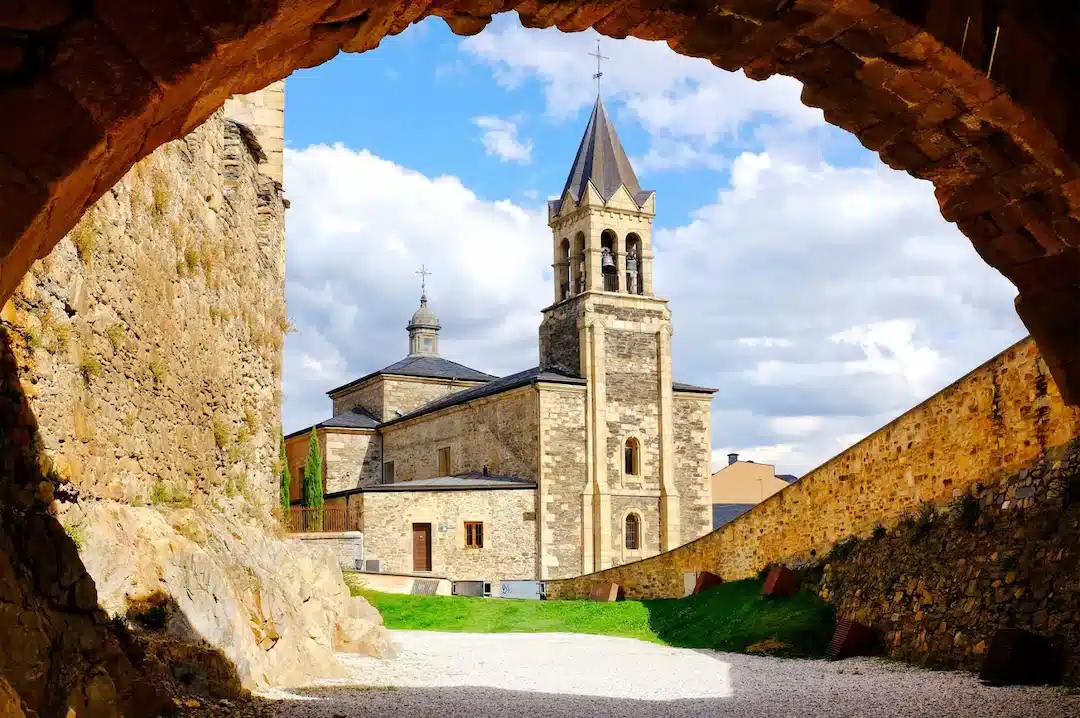
Ponferrada is a municipality and city in the province of León, capital of the region of El Bierzo. Surrounded by mountains and located in the heart of the Camino de Santiago, it is also known as ‘The city of the Templars’ because of its castle, one of the most spectacular fortresses in Spain, declared a National Monument. It is said that one of the reasons why the castle was modified on numerous occasions was to provide greater security for the pilgrims on their way through the city.
Located in Lugo, Galicia, it is one of the most popular points on the French Way. Here thousands of pilgrims decide to start the pilgrimage every year to make the popular route Sarria-Santiago de Compostela. This Galician town is about 100 km from Santiago de Compostela, the minimum distance needed to obtain the Compostela.
In Sarria you can visit dolmens and petroglyphs around the town that show the human presence in the area since prehistoric times.
The collegiate church of Roncesvalles is a jewel of Gothic architecture founded in the 12th century by King Sancho VII of Navarre to serve as a hospital and refuge for pilgrims on their way to Santiago de Compostela.
Today, the Collegiate Church of Roncesvalles continues to be a place of pilgrimage for pilgrims on the Way of St. James, many of whom stop here to rest and admire its beauty before continuing their journey to Santiago de Compostela.
Considered to be one of the most important monuments of civil architecture on the Santiago de Santiago, the bridge of Puente La Reina was built in the 11th century to facilitate the passage of pilgrims leaving the town.
It has 6 semicircular arches and one submerged arch and, in the past, in its centre there was a defensive tower that contained an image of the Virgin of El Puy, patron saint of the town. In addition to the central tower, the bridge had two other defensive towers at its end.
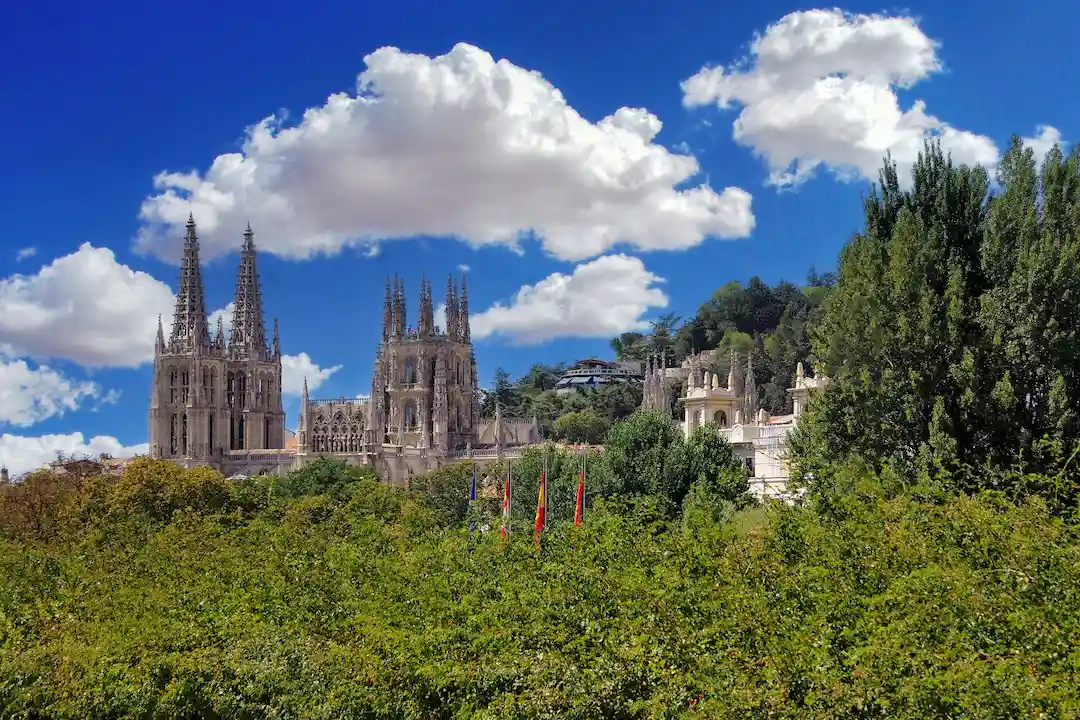
Declared a World Heritage Site and National Monument, Burgos Cathedral is one of the most representative monuments of French Gothic architecture in Spain. Its construction began in 1221, but it was not until 40 years later that it was completely finished.
In addition to its architectural beauty, Burgos Cathedral has a rich history linked to the Camino de Santiago, making it an obligatory stop for pilgrims on their way along the French Way.
As you pass through León, you will come across one of the monumental jewels of the French Way, its Cathedral. This Gothic basilica dates from the 13th century and is one of the city’s most important historical points of interest. One of the treasures of this cathedral are its stained glass windows, one of the most outstanding collections of Gothic art in Europe, which create a mystical and luminous atmosphere inside. An unforgettable visit for pilgrims.
The Episcopal Palace of Astorga, a legacy of the architect Gaudí, is an imposing neo-Gothic building located in the heart of the city.
It is an ensemble of castle, temple and stately mansion built in white granite stone between the 19th and 20th centuries and currently houses the Museum of the Caminos, dedicated to the Camino de Santiago.
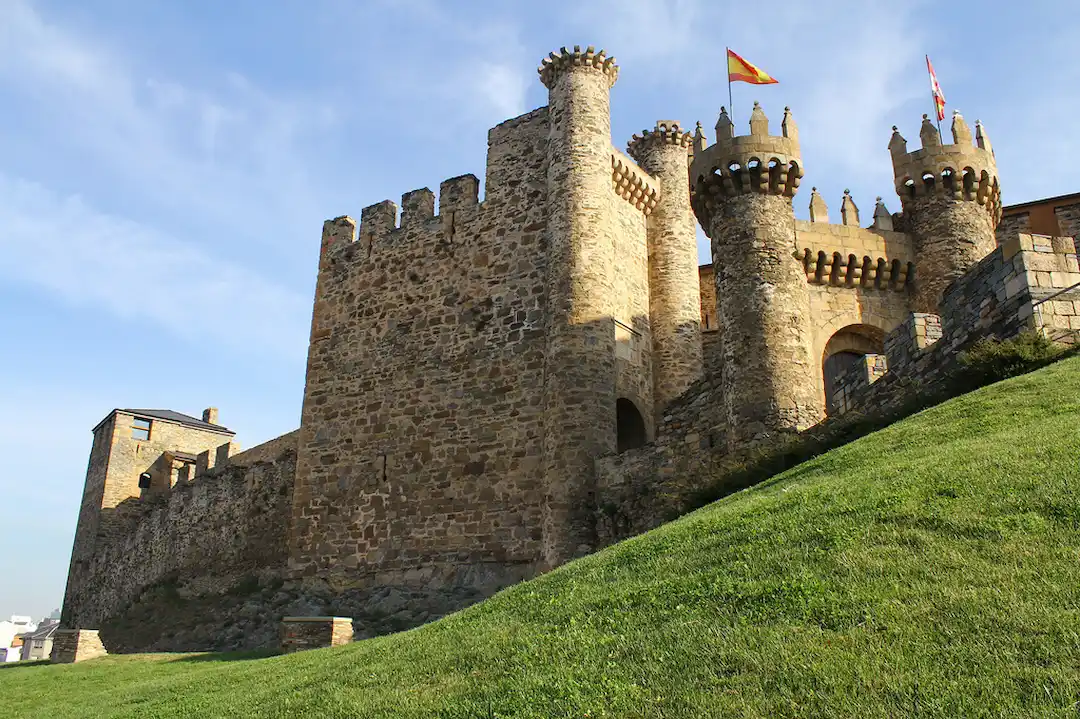
Approaching the end of the route, we reach the municipality of Ponferrada. Situated on a hill, we find the Castle of the Templars, a Romanesque-style building dating from 1187 and one of the wonders of the Middle Ages, declared an Asset of Cultural Interest and a National Monument.
This historic site has a special relationship with pilgrims. During the Middle Ages, the Knights Templar were known for their work protecting and lodging travellers on their way to Santiago de Compostela.
The Church of San Martín de Frómista is one of the jewels of Romanesque architecture on the Camino de Santiago. It was built in the 11th century and, together with the Cathedral of Santiago and the Basilica of San Isidoro, among others, is the pinnacle of Romanesque art of that century in Spain.
It stands out for its façade decorated with sculptures and reliefs representing biblical and symbolic scenes, as well as for its octagonal bell tower, which adds elegance and verticality to the whole.
| DISTANCE: | 740 Km |
|---|---|
| STAGES: | 34 Stages |
| LENGTH: | 35 Nights |
| DIFFICULTY: | 5/5 |
| STARTING IN: | St. Jean P.P. |
| PRICE: | from 3176€ |
We will design an itinerary tailored to your needs, preferences and budget and book all services for you. You enjoy the road.
Galicia is our home. We have traveled all the routes of the Camino and we have direct contact with the service providers on the Camino.
We speak several languages, have lived abroad and have years of experience organizing trips for people from all over the world.
Hundreds of pilgrims repeat year after year the experience of traveling with us. We want you to be one of them. And that is why we will strive to make your trip unique and unforgettable.
GET 10% OFF
Confirm your reservation between 21/11 and 02/12.