

Who hasn’t heard of Tuscany at some point in their lives?
Undoubtedly, this is the most popular route of the Via Francigena .
In fact, it will allow you to walk through one of the most beautiful regions, whose cities are among the most famous and visited in the world.
Among the cities listed as World Heritage by UNESCO you can visit San Gimignano, Siena and Florence.
Not only you will be able to enjoy the beautiful landscape of rural and urban Tuscany. Also, you will be able to taste the delicious gastronomy. All of this, accompanied by a good glass of one of the local wines in an impressive natural environment.
Therefore this is a unique opportunity to enjoy spectacular scenery in the company of many pilgrims from all over the world.
If you feel the stages are too long, don’t worry, we can offer you the possibility of splitting them in two and staying halfway, so you can walk at your own speed.
Galiwonders will help you to make the most of this vital experience. We will take care of the logistics, so that you can just concentrate on enjoying your walk.
Although Lucca may not be as famous as other Tuscan cities, its wonderful historic center is undoubtedly worth a visit. Its exceptionally well-preserved medieval and Renaissance walls enclose an old town brimming with heritage. Interestingly, these walls—which were never used to defend the city against a siege—were actually used for car racing in the 20th century.
Music has always played a fundamental role in Lucca: famous composers such as Giacomo Puccini (author of world-renowned operas like La Bohème or Tosca) were born here, and his museum can be visited in the city. Today, this tradition lives on through the Lucca Summer Festival, a major summer event that has hosted international stars such as Eric Clapton, Roger Waters, and Santana.
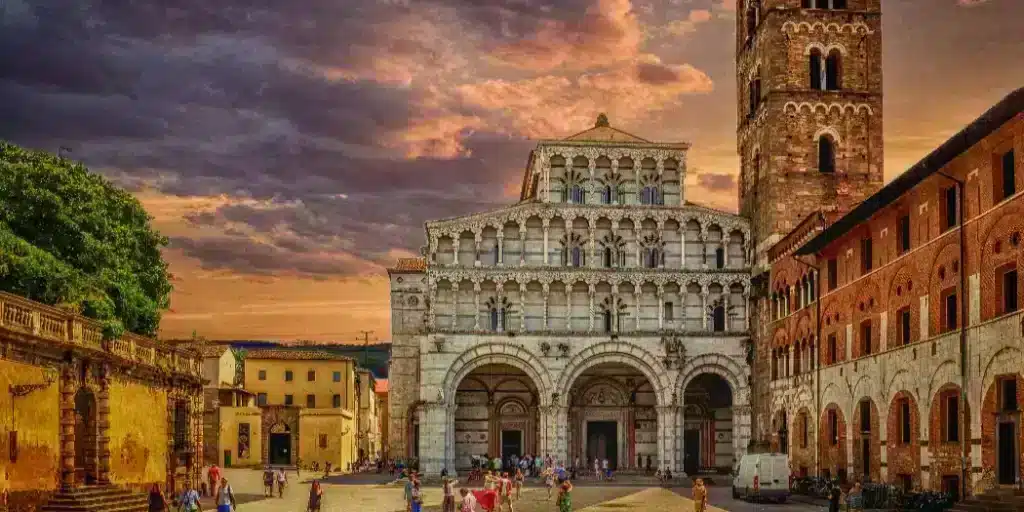
Known as “the city of 100 towers and 100 churches,” visits to the imposing Cathedral of St. Martin and the Guinigi Tower (built in 1390 with a curious rooftop garden growing holm oaks) are highly recommended. You also shouldn’t miss the elliptical square built over the ancient Roman Amphitheater—a perfect spot to recharge your batteries at a local restaurant or shop at traditional boutiques.
Itinerary Alternatives: After visiting Lucca, you can follow the Via Francigena on foot toward Altopascio. However, another popular option among pilgrims is to travel directly to San Miniato (via transfer or public transport) and resume the walk from there.
This is a relatively light stage that allows you to admire the parish church of Capannori, featuring a 13th-century façade. After walking through an industrial area, you will enter Porcari, home to the remains of the Badia di Pozzeveri. This was an exceptionally important monastic site in the 13th century when Camaldolese monks resided there.
Following a gentle and flat route, you will reach Altopascio, known as the “bread town.” Here you will find its famous medieval hospital built to offer assistance and shelter to pilgrims. It became a crucial strategic site where the Order of the Knights of Tau was founded in 1060, spreading its charitable work across Europe.
Leaving the walls of Altopascio behind, you will immerse yourself in Tuscan nature through the wild, wooded countryside of Cerbaie. After enjoying a landscape filled with forests and farmhouses, you will tackle a short section of gentle ups and downs before reaching the fortified Medici bridge (16th century) at Ponte a Cappiano.
Passing through the ancient town of Fucecchio with its medieval tower, you will cross the Arno River toward the charming fortified town of San Miniato—a place visited twice by Napoleon Bonaparte himself. After admiring the seminary, the Cathedral, the Bishop’s Palace, and the iconic Tower of Frederick, you can relax with a fine dinner featuring white truffle, the local delicacy par excellence.
A stage as demanding as it is gorgeous! Along this stretch, you will enjoy breathtaking panoramic views over the Val d’Elsa while walking through oak and chestnut forests. Today, the route is the epitome of the quintessential Tuscan landscape, world-famous for its olive groves and vineyards perched atop rolling hills.
Along the way, you will pass through Chianni, home to the Pieve di Santa Maria Assunta, a beautiful 12th-century Romanesque church. Near the end of the stage, after a final 300-meter climb, you will arrive in Gambassi Terme. As a reward for your effort, you can unwind at the Gambassi thermal baths. In medieval times, besides being a key stop for pilgrims, this town was a renowned glassmaking center throughout Italy.
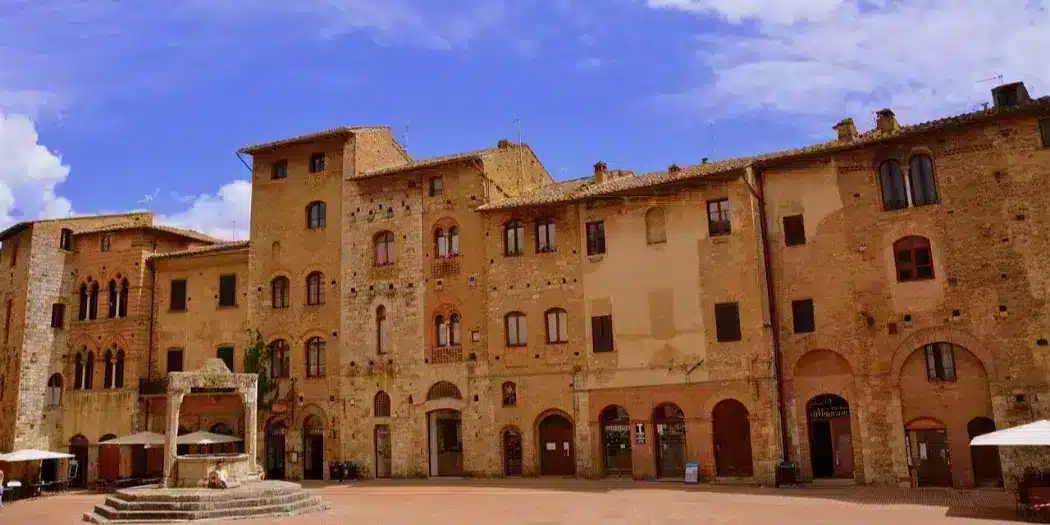
This stage features rolling terrain with some ups and downs, but the stunning scenery makes every effort worthwhile. Crossing the Chianti vineyards—famous for producing one of the most celebrated wines in the world—you will arrive in magical San Gimignano, a UNESCO World Heritage Site.
Considered by many to be one of the most beautiful towns in Italy, it has been dubbed the “Medieval Manhattan” for its soaring towers, which were true skyscrapers for their time. In the Middle Ages, the height of these towers served as a symbol of power and wealth among wealthy rival families. The 1300s Museum offers visitors an in-depth look into medieval architecture and society, while the boldest travelers can visit the Torture Museum.
However, San Gimignano is not just about history: its food and wine deserve special attention. Highlights include its famous dry white wine (Vernaccia di San Gimignano) and traditional dishes like panzanella, pappardelle, or ribollita. To top off your meal with a delicious dessert, visit Gelateria Dondoli in the main square—an award-winning ice cream shop that has been named the best gelateria in the world on multiple occasions.
(Gentler option: This stage is part of the split route between San Gimignano and Monteriggioni, ideal for those who prefer to walk at a more relaxed pace).
Leaving San Gimignano, the trail winds pleasantly through vineyards, hills, and Tuscan countryside until reaching the charming town of Colle di Val d’Elsa. Upon reaching the upper town (Colle Alta), you can enter through the historic Porta Volterrana, which once granted access to the old city through its defensive walls. From its viewpoint, you will enjoy incredible panoramas over the valley—perfect for a peaceful stroll through a town steeped in history, tradition, and famous for its crystal craftsmanship.
(Gentler option: Second half of the split itinerary).
Leaving Colle di Val d’Elsa behind, the path descends toward Castel Petraio and passes through Abbadia a Isola, where you can visit its monumental 11th-century monastic church before continuing toward the hilltop town of Monteriggioni.
This medieval town is completely encircled by circular walls that remain perfectly preserved since the 13th century. The fourteen towers lining its perimeter played a key role in defending Tuscany against Florentine invasions. Those very towers were cited by the famous Tuscan poet Dante Alighieri in The Divine Comedy to evoke the image of giants surrounding the infernal abyss. The unique charm of this town has also captivated modern artists, serving as a filming location for movies such as The English Patient, Gladiator, and Life is Beautiful.
The final 18 km separating you from another Tuscan marvel—also a UNESCO World Heritage Site—are relatively straightforward, though keep in mind that there are virtually no water or food stops along this rural stretch until you approach the city.
You will finally arrive in Siena, one of Italy’s most famous and visited destinations. Its food and wine, art, medieval architecture, and renowned “Palio” make it a true jewel. Legend has it that Siena was founded by Aschius and Senius, sons of Remus and nephews of Romulus (the founder of Rome).
Siena is home to one of the oldest universities in the world (founded in 1240) and retains much of its medieval appearance. Must-see attractions include the 12th-century Cathedral and the Museo dell’Opera del Duomo, which houses masterpieces by Donatello and Duccio di Buoninsegna. In the extraordinary fan-shaped Piazza del Campo stand the Palazzo Pubblico and the Town Hall with its famous Torre del Mangia. It is in this very square that the Palio is held—a unique horse race where seventeen jockeys represent the city’s historic districts (contrade).
Check out Siena
These hotels offer private rooms with private bathrooms, as well as other additional services that may vary depending on the category, such as restaurant service, television, room service, laundry, ironing, etc. It is common to stay in this type of hotel in the cities along the Camino.
These accommodations provide the essential services to meet basic hygiene and rest needs at a more moderate price than hotels. . Officially, hostels and guesthouses are classified as 1-star accommodations. However, this rating should not be taken into account when assessing the level of comfort and quality of their services.


The Renaissance Walls: A fully preserved circular rampart of over 4 km, now transformed into a tree-lined park ideal for a stroll before starting the trek.
Guinigi Tower: A famous 1390s medieval tower featuring a unique rooftop garden with live holm oaks, offering panoramic views over the city.
Piazza dell’Anfiteatro: An elliptical square built upon the ruins of an ancient Roman amphitheater, filled with bustling outdoor terraces and local artisan shops.
Musical Heritage: The birthplace of Giacomo Puccini (featuring his house-museum) and host to the renowned Lucca Summer Festival.
Altopascio & the Knights of Tau: A key historical hub for European pilgrimages where the Order of the Knights of Tau was founded in the 11th century to provide shelter and care to travelers in its famous medieval hospital.
San Miniato & White Truffles: A hilltop fortified town famous for its heritage (the Tower of Frederick, the Bishop’s Palace) and for being one of Tuscany’s capitals for white truffles.
The Medieval Towers: Preserves 14 of the original 70+ towers erected as symbols of wealth and power among competing affluent families during the 14th century.
Food & Wine Experience: Home to the world-famous Vernaccia di San Gimignano white wine, traditional dishes like ribollita or pappardelle, and the award-winning Gelateria Dondoli in its main square.
Cultural Highlights: Unique spaces such as the 1300s Museum and the intriguing Torture Museum.
Colle di Val d’Elsa (Colle Alta): A historic hilltop town renowned for its crystal-making tradition, ancient city walls, and the scenic viewpoint at Porta Volterrana.
The Fortress of Monteriggioni: An iconic circular walled village perfectly preserved since the 13th century. Its 14 towers inspired Dante Alighieri in The Divine Comedy and served as a backdrop for films like Gladiator, The English Patient, or Life is Beautiful.
Piazza del Campo: An extraordinary fan-shaped square dominated by the Palazzo Pubblico and Torre del Mangia, home to the historic Palio di Siena horse race.
Siena Cathedral (Duomo): A breathtaking Romanesque-Gothic cathedral housing artistic treasures by masters such as Donatello and Duccio di Buoninsegna.
Atmosphere & History: One of Europe’s best-preserved medieval cities, featuring a university founded in 1240 and vibrant historical districts.

| DISTANCE: | 134 Km |
|---|---|
| STAGES: | 6 |
| DURATION: | 7 Noches |
| DIFICULTY: | 3/5 |
| STARTI: | Lucca |
| PRICE: | desde 856€ |
We will design an itinerary tailored to your needs, preferences, and budget, and we will book all services for you. You just enjoy the journey.
Galicia is our home. We have traveled all the routes of the Camino and have direct contact with service providers on the Camino.
We speak several languages, have lived abroad, and have years of experience organizing trips for people from all over the world.
Hundreds of pilgrims repeat the experience of traveling with us year after year. We want you to be one of them. And that's why we will strive to make your trip unique and unforgettable.
GET 10% OFF
Confirm your reservation between 21/11 and 02/12.