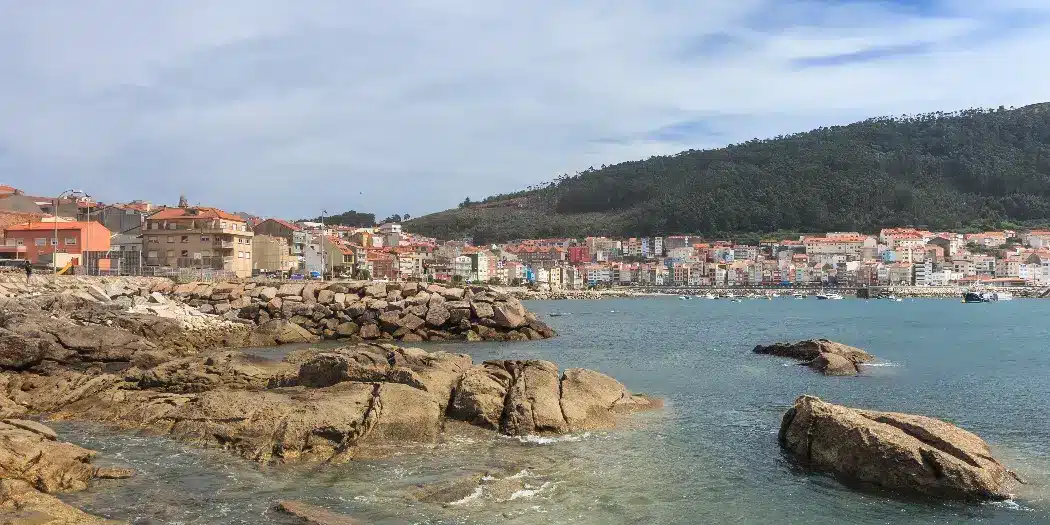
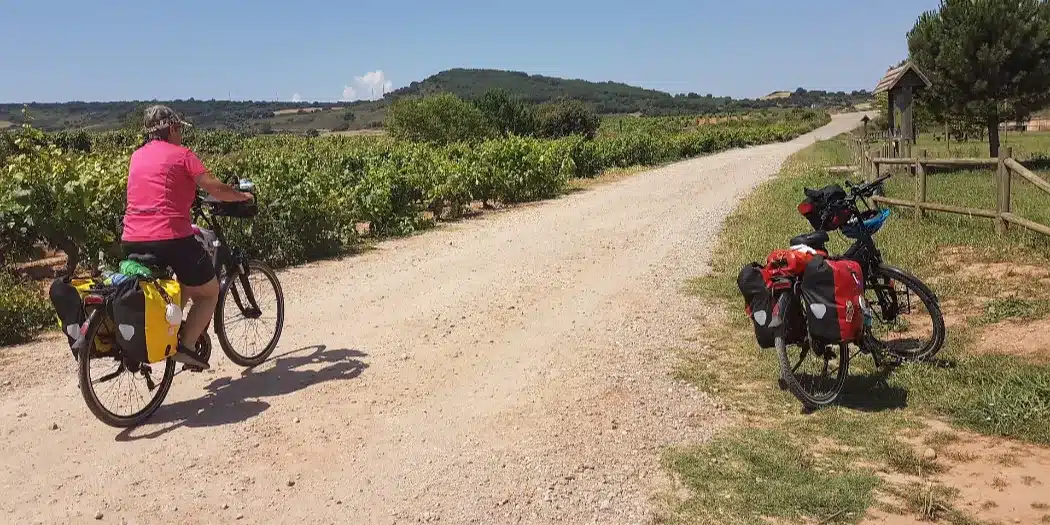
The Camino de Santiago from Lisbon by bike is a unique experience, taking you through beautiful landscapes, charming villages, and historic cities. Starting in Lisbon, you’ll discover the essence of Portugal, exploring its colorful streets that have witnessed centuries of history, along with its rich culture and cuisine.
The Portuguese Way is the second most popular route after the French Way, making it ideal for cycling pilgrims seeking the perfect balance between adventure and calm.


The Camino de Santiago from Lisbon by bike follows the Portuguese Way, one of the most popular routes of the Camino. On this itinerary, you will cycle approximately 595 kilometers over 13 stages.
If you’re concerned that the stages might be too long or prefer a more relaxed pace, keep in mind that our itineraries are fully flexible. We can split stages into two or add extra nights so you can rest.
Check in Lisboa
In this stage, we will have the opportunity to explore a variety of landscapes, historical and cultural sites, and enjoy the rich history and natural beauty of the region. The journey begins in Lisbon, the vibrant capital of Portugal. From the city, we’ll pedal north, passing through urban and suburban areas as we leave the city behind. Along the way, we’ll enjoy panoramic views of the Tagus River and the surrounding countryside.
The first half of this stage offers some interesting points as we follow the banks of the Tagus River. However, the final 16 kilometers can be challenging, as there are no towns or shaded areas along the way. But don’t worry—at the end of the route awaits Santarém, a city full of history that will quickly make you forget the day’s efforts.
In this stage, we’ll cycle through flat, sunny landscapes surrounded by vineyards and cornfields. We’ll also encounter some climbs and descents on dirt tracks and pass through eucalyptus forests and a few paved sections. At the end of the route awaits Tomar, the historic Templar city, which is truly charming and very popular with visitors,
This stage begins along a beautiful trail by the Nabão River and then passes through dehesas with holm oaks, olive trees, and some pines. Along the way, you’ll also see garden plots and scattered fruit trees, as well as some paved sections. The day ends in Alvorge, a charming village with whitewashed houses and a very welcoming atmosphere for pilgrims.
Los primeros kilómetros de esta etapa son realmente magníficos y ondulados, sin duda lo mejor desde que salimos de Lisboa. Además, en Rabaçal y en Conimbriga encontrarás restos de su pasado romano. La etapa termina en la preciosa ciudad de Coimbra, que fue la primera capital del reino de Portugal después de independizarse de León en 1139, la cual alberga una de las universidades más antiguas de Europa y tiene un ambiente estudiantil muy animado.
Leaving Águeda, we have two options: cycle along the road or pass through an industrial estate. It’s a relaxed, rural section where you can soak in the tranquility of the Portuguese countryside. This stage also features a passage through the historic center of Bemposta. As we enter São João da Madeira, the area becomes increasingly dense and industrial, gradually bringing us closer to the nearby city of Porto.
This stage begins in Porto and ends in Arcos, taking us inland away from the coast. Cycling over the magnificent Dom Zameirote Bridge, we’ll discover the typical vegetation of northern Portugal, with its pines and eucalyptus trees—a great opportunity to enjoy the shade of the forest as we ride along the route.
Today we face a longer and more challenging stage. We’ll arrive at the beautiful town of Ponte de Lima, one of the oldest in Portugal. Here, we can see the two sections of the bridge that crosses the Lima River and gives the town its name—one dating from the Roman era and the other from the medieval period.
This stage takes us into Galicia, crossing the bridge over the Miño River, which marks the natural border between Spain and Portugal. The town of Tui is definitely worth a visit, with its cathedral and charming historic center—perfect for a relaxing stroll through its streets.
This is a medium-level stage that takes us from Tui to Redondela, where we can admire the beautiful views of the Ría de Vigo.
La etapa de hoy nos llevará a uno de los pueblos más hermosos de toda Galicia, Pontevedra. Cruzaremos el río Verdugo en Ponte Sampaio, donde luchó la armada de Napoleón. Desde Ponte Sampaio, la ruta nos llevará a Pontevedra. Aquí podremos pasear por el centro histórico con sus plazas y edificios en piedra, visitaremos la Iglesia de Santa María y degustaremos alguno de sus platos típicos de las Rías Baixas.
Today’s stage takes you through Barro and the beautiful Río Barosa Natural Park, with its waterfalls and mills. You’ll also pass through Caldas de Reis, an iconic stop on the Camino de Santiago. After cycling along wooded trails and villages with scattered houses, you’ll reach today’s final destination, Padrón. This town is famous as the birthplace of great Galician writers like Rosalía de Castro and Camilo José Cela, and according to tradition, it was the first place sighted by the boat carrying the remains of the Apostle Santiago. And who doesn’t know the famous saying about Padrón peppers: ‘some are hot, and some are not’?
The final stage of your cycling journey takes you to Santiago—don’t forget to stop by the Pilgrim’s Office to request your Compostela. Starting through rural areas, the landscape gradually becomes more urban as you approach Santiago. The magnificent city, a UNESCO World Heritage site, is worth exploring, from its historic center streets to the Mercado de Abastos, where you can experience the local products of the region firsthand.
Check Out Santiago de Compostela

The Camino de Santiago from Lisbon by bike covers approximately 595 km with a moderate level of difficulty, including some mountainous sections and notable elevation changes when entering Galicia.
Route
The terrain along the Portuguese Way from Lisbon varies throughout the route, so you’ll cycle across a wide range of surfaces, including rural paths, farmland tracks, and paved or asphalt roads as you approach towns and cities.
Elevation
The Camino de Santiago from Lisbon presents different characteristics along the way. Some areas, like the surroundings of Coimbra or the stretch between Santarém and Tomar, are more undulating, while other sections—especially in the Labruja Mountains and between Redondela, Pontevedra, and Monte do Gozo in Galicia—feature steeper climbs.
Signage
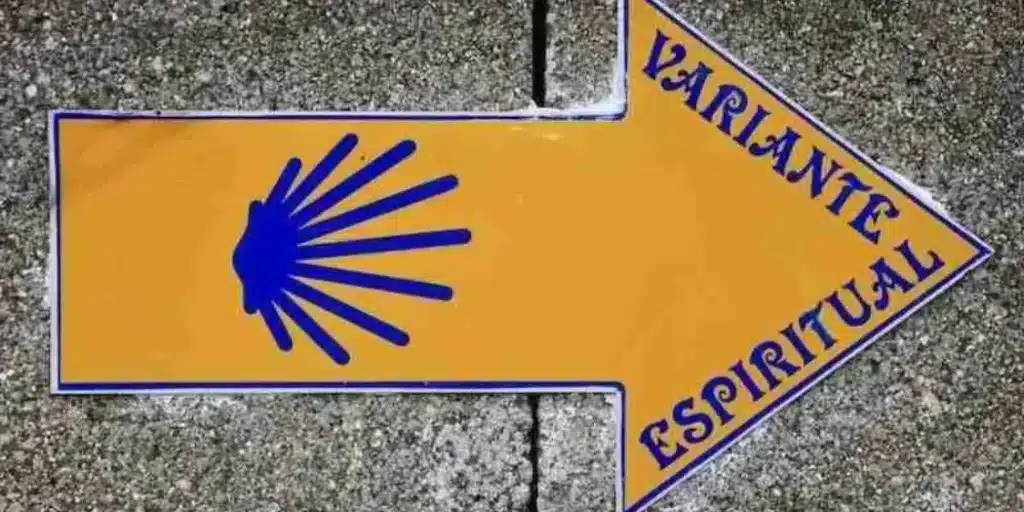
You can follow the route without problems by looking for the various markers: stone milestones, the iconic scallop shell tiles on building facades or urban constructions, yellow arrows, or bronze scallop shells embedded in street pavements.
We recommend paying close attention to these signs in both urban and rural areas, as they can sometimes be hidden or blocked by objects like cars or pedestrians, which might lead you off the correct path. If you reach a junction with no visible markers and are unsure which way to go, it’s best to return to the last sign you saw to reorient yourself.
Important note:
You may encounter signage in the shape of the iconic scallop shell that is not accompanied by a yellow arrow. In such cases, follow the shell from its open side—the semicircular part with the larger diameter—as if it were an imaginary arrow.
These hotels offer private rooms with private bathrooms as well as other additional services that may vary depending on the type of category: restaurant service, television, room service, dry cleaning, ironing service, etc. It is common to stay in this type of hotels in the cities along the Camino.
These accommodations have the necessary services to cover the basic needs of cleanliness and rest at a more moderate price than the hotels . Officially, hostels and guesthouses are 1-star accommodations. However, this rating should not be taken into account when evaluating the level of comfort and quality of their services.


The Camino de Santiago dates back to the 9th century, when the remains of the Apostle Santiago were discovered in Santiago de Compostela. The news quickly spread worldwide, turning the city into a major pilgrimage center.
Lisbon, with its rich historical and cultural heritage, plays an important role in the pilgrimage to Santiago de Compostela, serving as the starting point for many pilgrims.
As one of the oldest cities in Europe, Lisbon’s history stretches back over 3,000 years. Its strategic location at the mouth of the Tagus River—the longest river in the Iberian Peninsula—and at the southwestern tip of Europe made it a key point for trade with Africa and the Americas, contributing to its wealth and cultural diversity over the centuries.

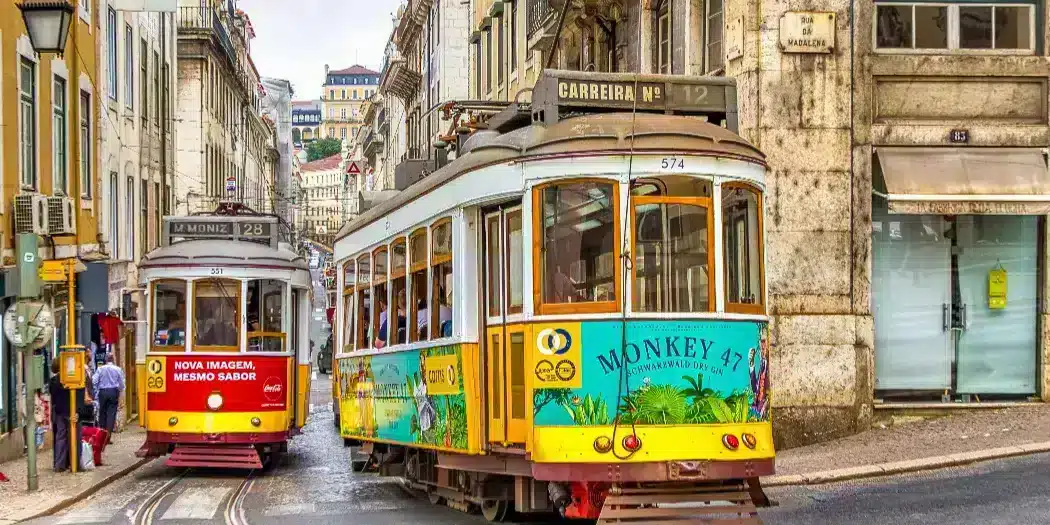
Lisbon is one of Europe’s oldest cities and one of the most popular starting points for the Portuguese Way. Situated at the mouth of the Tagus River, Lisbon is the capital of Portugal and one of the continent’s most fascinating cities. Its streets feature the famous trams, symbols of the city and a preferred mode of transport for locals.
Azambuja
This small town in the Lisbon district is notable for its historical heritage reflected in monuments and buildings, such as the 16th-century Church of Nossa Senhora da Assunção, considered a Building of Public Interest, and the parish of São João Batista, of great architectural value.
Santarém
A medieval town that takes you back to Portugal’s Middle Ages, Santarém is considered the Gothic capital of Portugal. Highlights include the Convento de São Francisco and the Jardim das Portas do Sol, surrounded by ancient walls and offering one of the region’s most important viewpoints.
Coimbra
Once the medieval capital of Portugal for over a century, Coimbra holds significant historical and cultural importance from the Middle Ages.
Porto

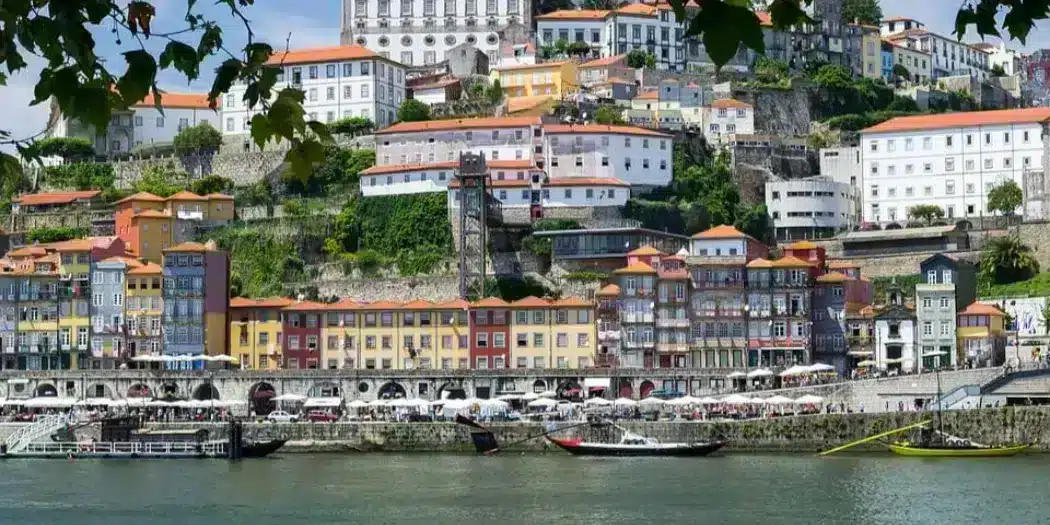
A UNESCO World Heritage Site, Porto is a cultural and architectural treasure on the banks of the Douro River. As Portugal’s third most populated city, it has one of Europe’s most beautiful historic centers and is a popular starting point for pilgrims on the Portuguese Way.
Tui
This small border town is considered “the gateway to Galicia” from the Portuguese Camino. It preserves its medieval historic and artistic heritage, including the Diocesan Museum, formerly a pilgrims’ hospital, which can be visited today.
Redondela
A charming town in the province of Pontevedra, located at the mouth of the Verdugo River within a privileged natural setting. Its rich historical and cultural heritage makes it an ideal stop to discover Galicia’s beauty and authenticity.
Pontevedra
Also known as “Boa Vila,” Pontevedra has a long maritime and commercial tradition and preserves one of Galicia’s most important and elegant historic centers. Closely linked to the Camino de Santiago, Pontevedra is considered the capital of the Portuguese Way.
Padrón
Located 22 km from Santiago de Compostela, this town is historically linked to the Apostle Santiago, whose remains were brought here from Jerusalem. It is also the birthplace of two important writers: poet Rosalía de Castro and Nobel laureate Camilo José Cela.
San Simón Island
At the end of the Ría de Vigo, San Simón Island has a mysterious and fascinating past. It served as a refuge for Templar knights and Benedictine monks during the Middle Ages, was attacked by pirates in the 16th century, and functioned as a concentration camp during the Spanish Civil War. Although not directly on the Portuguese Way, many pilgrims choose to visit this remarkable island for its historical and cultural significance.
São Jorge Castle in Lisbon
Perched on Lisbon’s highest hill in the heart of the Alfama district, São Jorge Castle was built in the mid-11th century during the Muslim occupation. It features 11 towers, courtyards, gardens, and terraces with stunning views of the Tagus River and the city, making it a National Monument.
Sé of Santarém
This historic building, a former Jesuit college, is a prime example of the city’s religious architecture. Its Mannerist façade and the Diocesan Museum inside are highlights you can visit along the way.
University of Coimbra

Dating back to the 13th century, the University of Coimbra is one of Europe’s and Portugal’s most prestigious academic institutions. A UNESCO World Heritage Site, it features the impressive Paço das Escolas complex, including the University Tower, the Chapel of Saint Michael, and other historic buildings reflecting the university’s evolution over time.
Cathedral of Santa María de Tui
Built in the 12th century, Santa María Cathedral is one of the most important buildings on the Portuguese Way. Although predominantly Romanesque, it features Gothic influences, particularly at its entrance, considered the first Gothic sculptural ensemble in the Iberian Peninsula. It also includes a medieval cloister, the only one of its kind preserved in Galicia.
Church of the Pilgrim Virgin in Pontevedra
One of Pontevedra’s most symbolic buildings, the Church of the Pilgrim Virgin is a Historic-Artistic Monument and a Cultural Asset of Interest. It combines late Baroque and neoclassical elements, including its main altarpiece from the 18th century. Dedicated to the Pilgrim Virgin, patron of Pontevedra and the Portuguese Way, it guided pilgrims from Baiona to Santiago. Its distinctive scallop-shell-shaped floor, a symbol of the Camino, incorporates a cross at its center.
Savor the Local Cuisine
Taste the delicious Portuguese and Galician gastronomy in the towns and cities along the Camino. Enjoy traditional dishes such as codfish, custard tarts, and octopus à feira.
Explore the Camino’s Culture
Visit the rich cultural and historical heritage along the route, including churches, cathedrals, and monasteries, learning about the history, architecture, and traditions of each region.
Enjoy Wine Tasting
Especially in Portugal’s wine regions, such as Alentejo and Douro, you’ll find wineries and vineyards where you can taste a wide variety of red and white wines—a unique experience that will enrich your journey along the Portuguese Way.

By car or taxi: It’s approximately 640 km to the center of Lisbon, with an estimated travel time of 5 hours and 40 minutes.
By bus: From the airport, you can take an ALSA bus to Lisbon, with a duration of around 10 hours and 30 minutes. You can check schedules and more information at www.alsa.es
By car: It’s approximately 550 km to Lisbon city center, with an estimated travel time of 5 hours.
By bus: From the airport, take the 6A bus line to the Intermodal Station. From there, you can catch an ALSA bus to Lisbon Intermodal Station, with an approximate duration of 9 hours. You can check schedules and more information at www.alsa.es
By car or taxi: It’s approximately 15 km to Lisbon city center, with an estimated travel time of 6 minutes.
By metro: You can take the metro towards Aeroporto-Saldanha, which takes around 20 minutes.
By bus: You can take a bus to Lisbon Bus Station, with a duration of approximately 8 minutes. You can check schedules and more information at www.aeropuertolisboa.pt
| DISTANCE: | 595 Km |
|---|---|
| STAGES: | 13 Stages |
| LENGTH: | 14 Nights |
| DIFFICULTY: | 4/5 |
| STARTING IN: | Lisboa |
| PRICE: | from 2429€ |
We will design an itinerary tailored to your needs, preferences and budget and book all services for you. You enjoy the road.
Galicia is our home. We have traveled all the routes of the Camino and we have direct contact with the service providers on the Camino.
We speak several languages, have lived abroad and have years of experience organizing trips for people from all over the world.
Hundreds of pilgrims repeat year after year the experience of traveling with us. We want you to be one of them. And that is why we will strive to make your trip unique and unforgettable.
GET 10% OFF
Confirm your reservation between 21/11 and 02/12.